A logo mat lives or dies on four line items, and none of them is the artwork. Two mats can carry the same printed logo and cost within a dollar of each other, yet one still looks sharp after a winter of salt and slush while the other has matted down, curled at the corners, and faded to a ghost. The difference is in the specification: the fiber on the surface, how much of it there is, what the mat is backed with, and how the print and edge are built. Here is how to read and write each of those four numbers so the mat you order survives the traffic you actually have.
Start with the fiber, matched to the zone
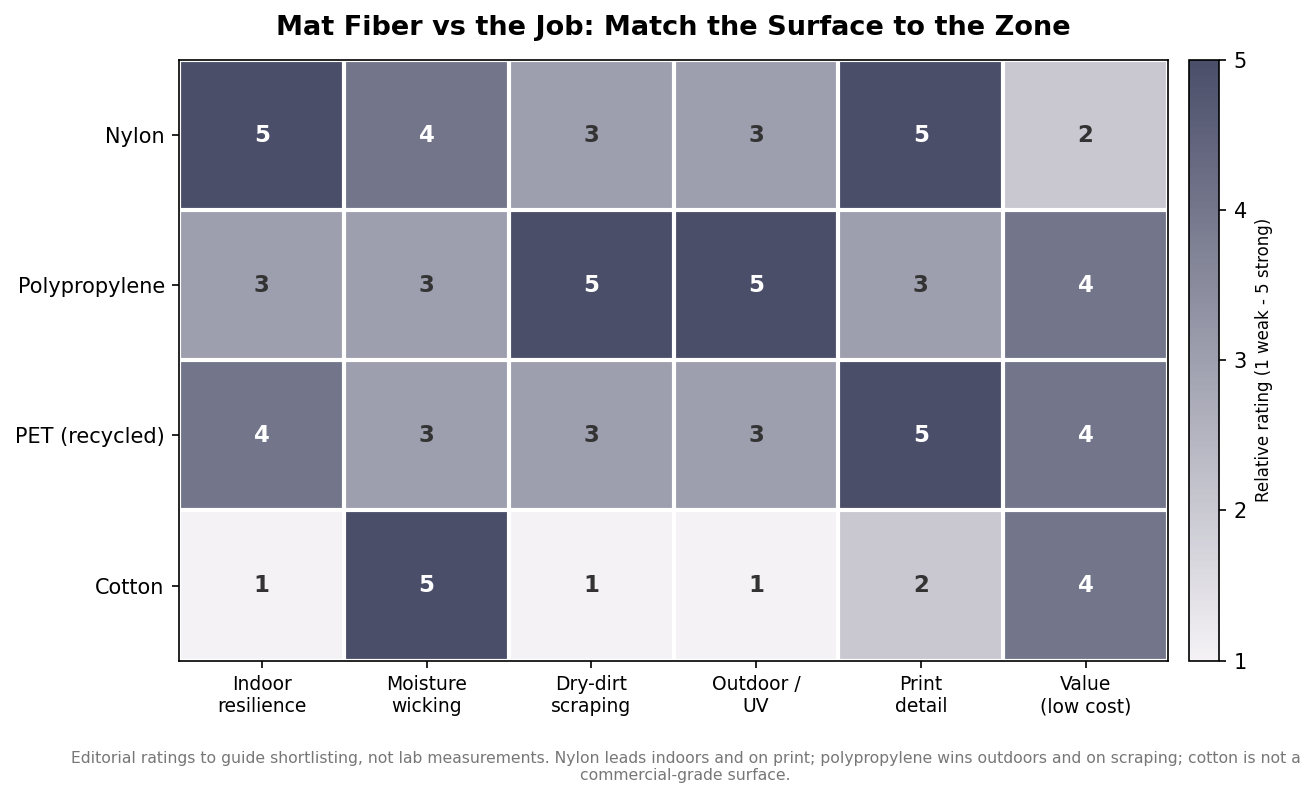
The fiber is chosen by placement, not by preference. Nylon is the default surface for indoor, high-traffic logo mats: it holds color, resists crushing under constant footfall, and takes high-definition print, which is why it anchors most lobby and reception mats despite being the priciest fiber. Polypropylene, also called olefin, is the outdoor and scraper fiber, because it shrugs off moisture, UV, and chemicals and its coarse texture is genuinely good at scraping dry grit off shoes, though it crushes faster than nylon under heavy indoor use. PET, the recycled polyester spun from post-consumer plastic, has become a real option where sustainability matters, since it prints cleanly and holds up reasonably while carrying a recycled-content story. Cotton and similar absorbent fibers wick water well but flatten quickly and are not a commercial-grade surface, so keep them out of a specification for a public entrance.
Face weight: how much yarn is actually there
Face weight is the amount of surface yarn per square yard, quoted in ounces, and it is the single best proxy for how a mat will wear. Commercial-grade carpet mats generally run in the range of 28 to 42 ounces, and within that band heavier is better in two ways: more yarn gives the tufts room to render fine logo detail and gradients, and it gives the traffic more material to grind through before the pile thins and the design starts to look tired. A light face weight can look fine on day one and still be the reason a mat looks worn out a year early. When you are comparing quotes, ask for the face weight in ounces explicitly, because it is the number most likely to be quietly cut to hit a price, and it is invisible in a photo.
The backing decides the lifespan
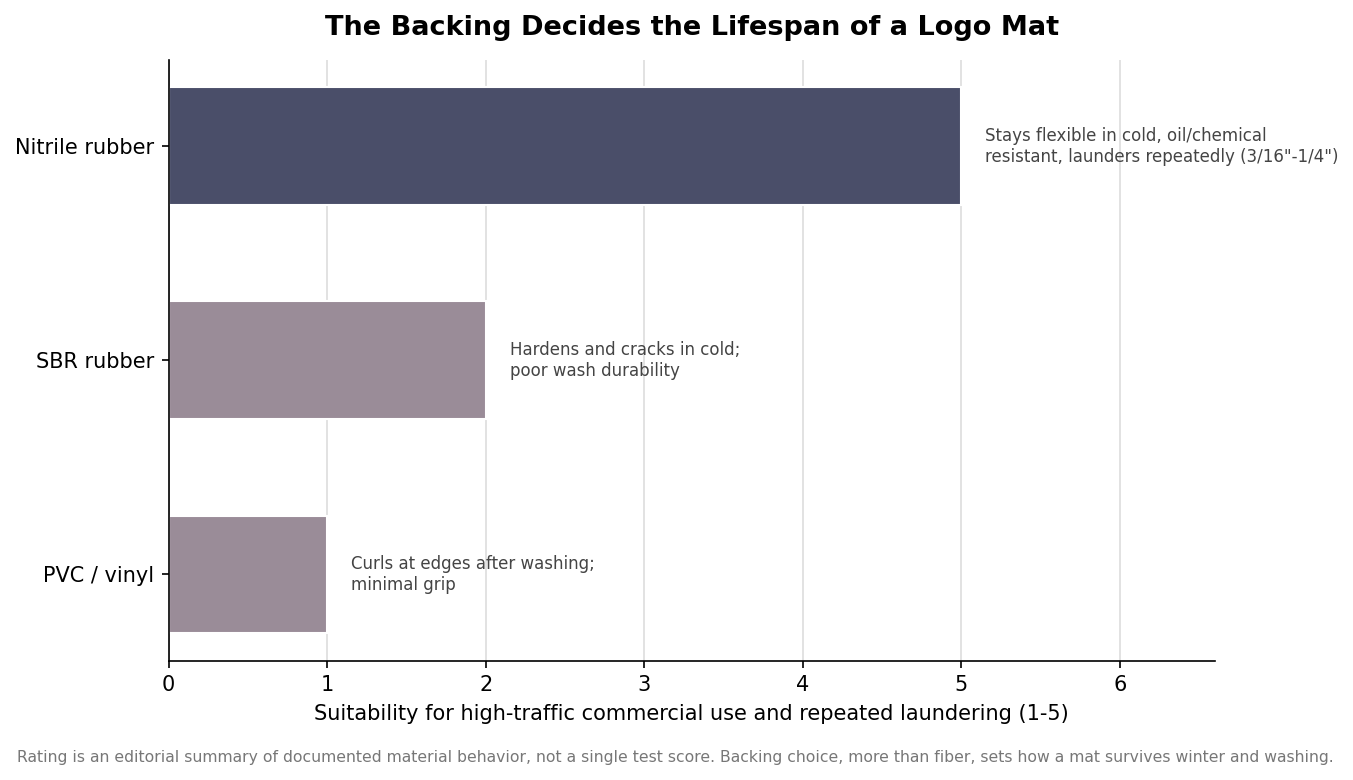
If the fiber is what people see, the backing is what determines how long they see it, and it is where cheap mats give themselves away. Nitrile rubber is the commercial standard: it stays flexible in cold temperatures, resists oil and chemicals, grips the floor, and survives repeated commercial laundering, typically in a 3/16 to 1/4 inch thickness that also resists curling. SBR rubber is the budget substitute, and it hardens and cracks in the cold while holding up poorly to washing, which limits it to light-duty indoor spots. PVC or vinyl backing is cheaper still, offers minimal grip, and tends to curl at the edges after a few wash cycles, which is both a wear problem and a trip hazard, so it does not belong under real commercial traffic. Backing choice, even more than fiber, is what separates a mat that lasts from one that fails in a season.
Print method and edge
How the logo gets into the mat matters as much as how good it looks new. High-definition dye injection, in which computer-controlled jets drive color down into the fiber, gives photo-quality detail, gradients, and effectively unlimited color, and it is the right choice for a detailed indoor logo. For outdoor and scraper mats, inlay or tufted-in construction embeds the color into the mat structure so there is no printed ink layer to abrade away, trading some fine detail for color that does not wear off. The edge is the last detail and an easy one to overlook: a beveled rubber border eases the transition from floor to mat, which reduces the trip hazard at the perimeter and helps the mat sit flat for accessibility, while a simple serged edge is lighter and cheaper but offers less edge protection on a thick mat. It is also worth confirming whether the border color and the surrounding bleed are part of the printed area or a separate rubber frame, because that choice changes how much usable space your logo actually has.
Putting the specification together
Write the four numbers down before you request a quote. A complete logo-mat spec reads something like: solution-dyed nylon surface, 36-ounce face weight, 1/4-inch nitrile rubber backing, HD dye-injection print, beveled border, in the finished size you need. Match those choices to the placement, so an exterior scraper zone flips to polypropylene with an inlay print and an interior wiper zone stays on heavy nylon, and a sustainability-led lobby considers PET without dropping below commercial face weight or backing grade. The point of specifying all four is that it takes any single one of them off the table as a place for a supplier to silently economize.
Get the fiber, the face weight in ounces, and the backing material in writing before you order, and if the placement sees weather or heavy traffic, ask for a sample to flex in the cold and check the edge. A mat that is underspecified does not fail loudly; it just quietly wears out ahead of schedule and takes your logo down with it.