A custom logo mat at a commercial entrance is easy to think of as branding, but the moment it is installed in a building open to the public it becomes a regulated floor surface. Three separate families of rules apply to it: flammability, slip resistance, and accessibility. A mat can be beautifully printed and still fail an inspection, void a lease clause, or create a liability if it ignores any of them. Here is what each standard actually requires and what to ask a supplier to prove.
Flammability: what a fire rating on a mat really means
Two different tests govern how a floor covering behaves in a fire, and they answer different questions. The first is the methenamine pill test, defined by ASTM D2859 and mandated federally under 16 CFR Part 1630 for carpets and rugs sold in the United States. A lit pill is placed at the center of a sample inside a steel frame with an eight-inch hole, and the material passes if the char does not spread to within one inch, 25 millimeters, of the edge of that hole. A production lot passes when seven of eight specimens meet that limit. This is a baseline ignition test that essentially all compliant carpet has to clear, so it is a floor, not a selling point.
The second test is the one that matters for commercial specification: critical radiant flux, measured by ASTM E648, which is technically identical to NFPA 253. It reports how much radiant heat energy a floor covering can withstand before flame stops spreading, in watts per square centimeter, and a higher number means the material resists flame spread better. Class I requires a critical radiant flux of at least 0.45 W/cm², while Class II covers the 0.22 to 0.44 W/cm² range. The chart below shows those thresholds.
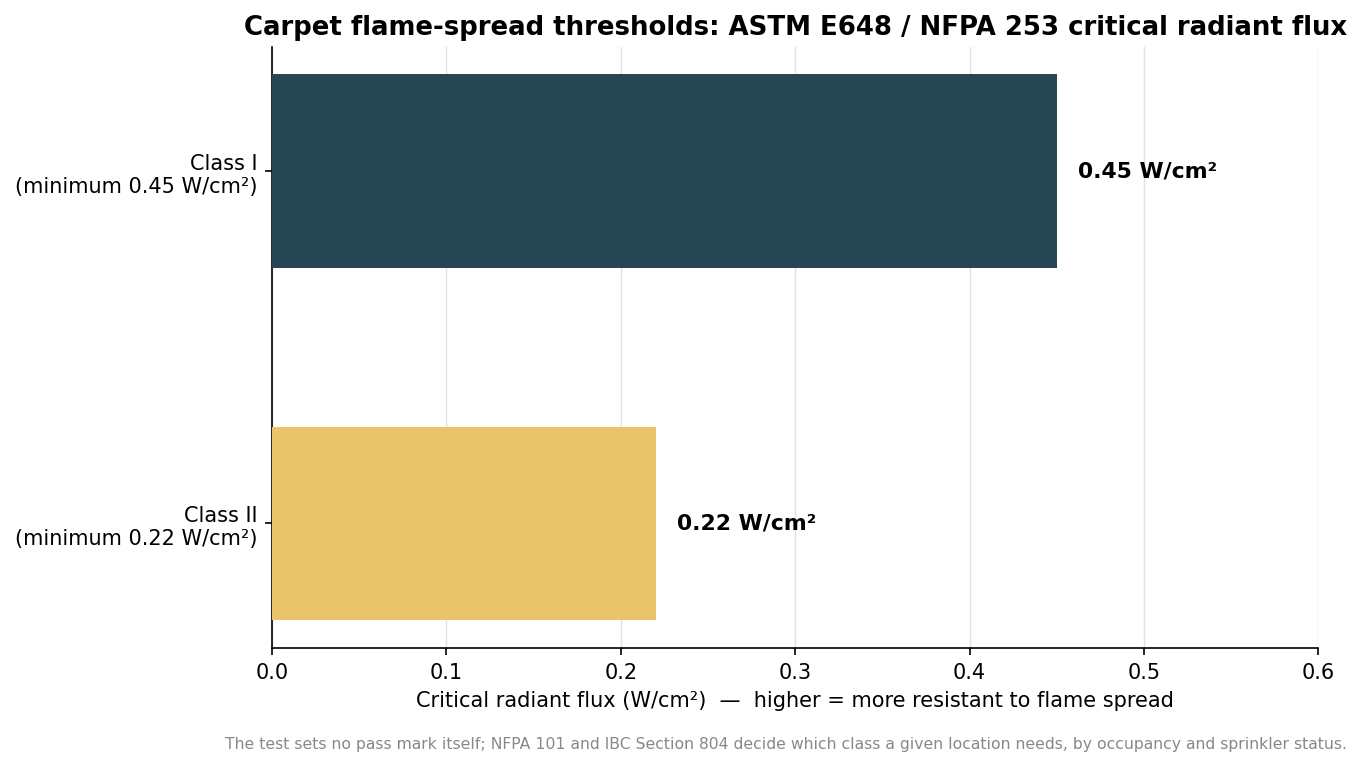
The important nuance is that the test itself sets no pass mark. The requirement to use Class I versus Class II comes from the building and life-safety codes, principally NFPA 101 and Section 804 of the International Building Code, and it depends on the occupancy type and whether the building is sprinklered. As a general rule, Class I, the more demanding tier, is what gets specified for exit corridors and egress paths in many occupancies, while Class II may be acceptable in other spaces. Because the exact rule is code- and occupancy-driven, the safe move is to ask which class your local code requires for the specific location and to confirm the mat is documented to that class.
Slip resistance: the numbers worth asking for
Slip resistance is where the marketing language is loosest, so it pays to insist on a measured value and the method behind it. The current hard-surface standard, ANSI A326.3, sets a wet dynamic coefficient of friction, or DCOF, of at least 0.42 for interior floors expected to be walked on while wet, with a higher 0.55 threshold for wet or outdoor conditions. Separately, the National Floor Safety Institute designates a surface as high-traction at a static coefficient of friction of 0.60 or above. Either figure is only meaningful alongside the test method and whether it was measured wet or dry.
Two honest caveats belong in any slip conversation. There is no single universal coefficient that guarantees safety across every surface and contaminant, and OSHA does not actually mandate a specific coefficient of friction for walking surfaces, despite the widely repeated 0.5 figure. For an entrance mat specifically, slip resistance has two parts: the traction of the walking surface itself, and the grip of the backing that keeps the mat from sliding on the floor beneath it. A mat that skates across a tile lobby is a hazard no matter how grippy its face is, so ask about both.
Accessibility: the ADA rules a mat can quietly break
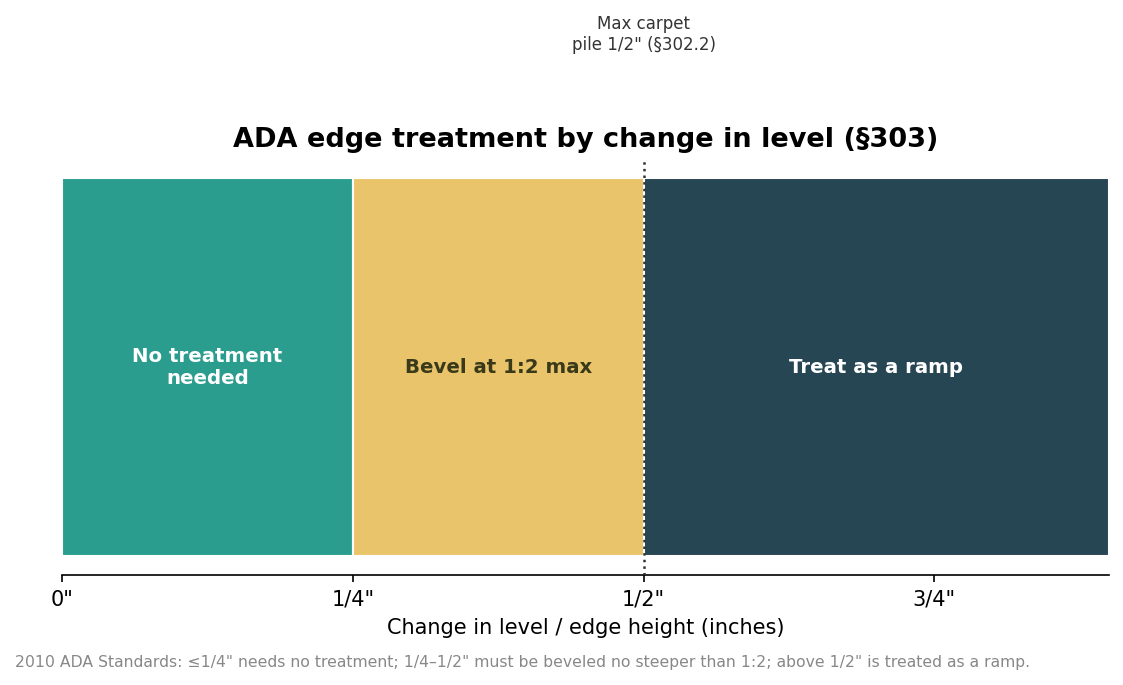
The most common way a mat runs afoul of the ADA is by being a trip hazard or an obstacle to a wheelchair. The 2010 ADA Standards set clear numbers. Carpet and mat pile height is capped at 1/2 inch, measured to the backing, cushion, or pad, under Section 302.2, and the carpet must be securely attached so it cannot shift or buckle, with exposed edges trimmed and fastened the entire length to stop curling. A loose, thick, curling mat violates the spirit and often the letter of that rule.
Then there is the edge itself, treated as a change in level under Section 303. A vertical rise up to 1/4 inch needs no special treatment, a rise between 1/4 and 1/2 inch must be beveled at a slope no steeper than 1:2, and anything above 1/2 inch has to be handled as a ramp. The chart below maps those three zones. This is why low-profile mats with tapered, beveled borders exist: they keep the transition inside the range that needs no ramp while still stopping a wheel or a toe from catching.
How the pieces fit a real entrance
Put together, the three standards point toward a fairly specific product for a public entrance. The mat should be thin enough that its edge stays within the 1/4-inch untreated range or is beveled at 1:2, its pile no more than 1/2 inch, its backing high-traction and heavy enough to stay put, and its fiber and construction documented to the critical radiant flux class your code requires for that location. None of these is exotic; entrance systems are built to hit all of them at once. The failure mode is buying on appearance and print quality alone and discovering the compliance gap after installation.
What to request in writing
Before a custom carpet or mat order is confirmed, ask the supplier to put five things on paper. Confirm the material passes the 16 CFR 1630 pill test, state the ASTM E648 critical radiant flux class and the actual W/cm² value, give a DCOF or slip-resistance figure with the test method and wet-or-dry condition, specify the finished pile height, and describe the edge construction and how the mat is secured. A supplier who can produce those numbers is selling a compliant floor surface; one who can only talk about colors and logos is selling a print, and the compliance gap becomes your problem at inspection time. The branding is the easy part, and it is worth making sure the surface underneath it meets the code it will live under.