Category: Uncategorized

  • Renting vs. Buying Custom Logo Mats: A Five-Year Cost Breakdown

    Renting vs. Buying Custom Logo Mats: A Five-Year Cost Breakdown

    Every business with a front door eventually faces the same pitch from a uniform-and-facility-services rep: don’t buy your entrance mats, rent them. A truck shows up on a schedule, swaps your dirty logo mats for clean ones, and you never think about laundering them. It sounds effortless, and for some operations it is the right call. But the recurring invoice hides a number most buyers never work out, which is what that convenience costs over the life of a mat you could have simply owned.

    This is a spending decision, not a design decision, so it deserves the same scrutiny you would give any other line item that renews forever. The math is not complicated, and once you see it laid out on a timeline the trade-off becomes obvious.

    What a rental program actually charges

    Rental pricing is usually quoted per mat, per week or per service visit. Published commercial-mat rates land in the range of roughly $3 to $5 per week for a standard 3-by-5-foot mat, which works out to about $156 to $260 per mat each year. Service intervals vary: some contracts swap mats weekly, others every two weeks or monthly, and the frequency is baked into the rate. A logo mat, because it carries printed or inlaid artwork, typically sits at the higher end of any rental card than a plain rubber-backed scraper mat.

    The figure that matters is not the weekly rate but the total across a multi-year contract. At $4 per mat per week, a single mat costs a little over $1,000 across five years. Run a modest fleet of five entrance mats and you are looking at roughly $5,000 over the same period, renewing indefinitely because the mats are never yours. Rental agreements also tend to run on multi-year terms with automatic renewal, so the meter keeps running until you actively cancel.

    What the same mat costs to own

    A comparable custom logo mat is a one-time purchase, and the number is smaller than most buyers expect. Published pricing for a 3-by-5-foot high-performance or logo mat generally falls between about $100 and $155, depending on fiber, backing, and print method. Buy it once and the artwork, the anti-slip backing, and the mat are yours. There is no service visit, no renewal clause, and no per-week meter.

    Ownership does carry a small ongoing cost, because a mat you own is a mat you clean. In practice that means vacuuming it on the same schedule you vacuum the rest of your floors and running a hot-water extraction or deep clean every six to twelve months. Amortized, that upkeep adds on the order of $20 to $30 per mat per year in labor and consumables, which is real but modest next to a rental invoice.

    The break-even point comes fast

    When you plot the two options as cumulative spending over time, the picture is stark. The rental line climbs steadily from day one because you pay every single week. The purchase line starts higher, at the upfront cost of the mat, then stays nearly flat, rising only with light maintenance. The two lines cross within the first year.
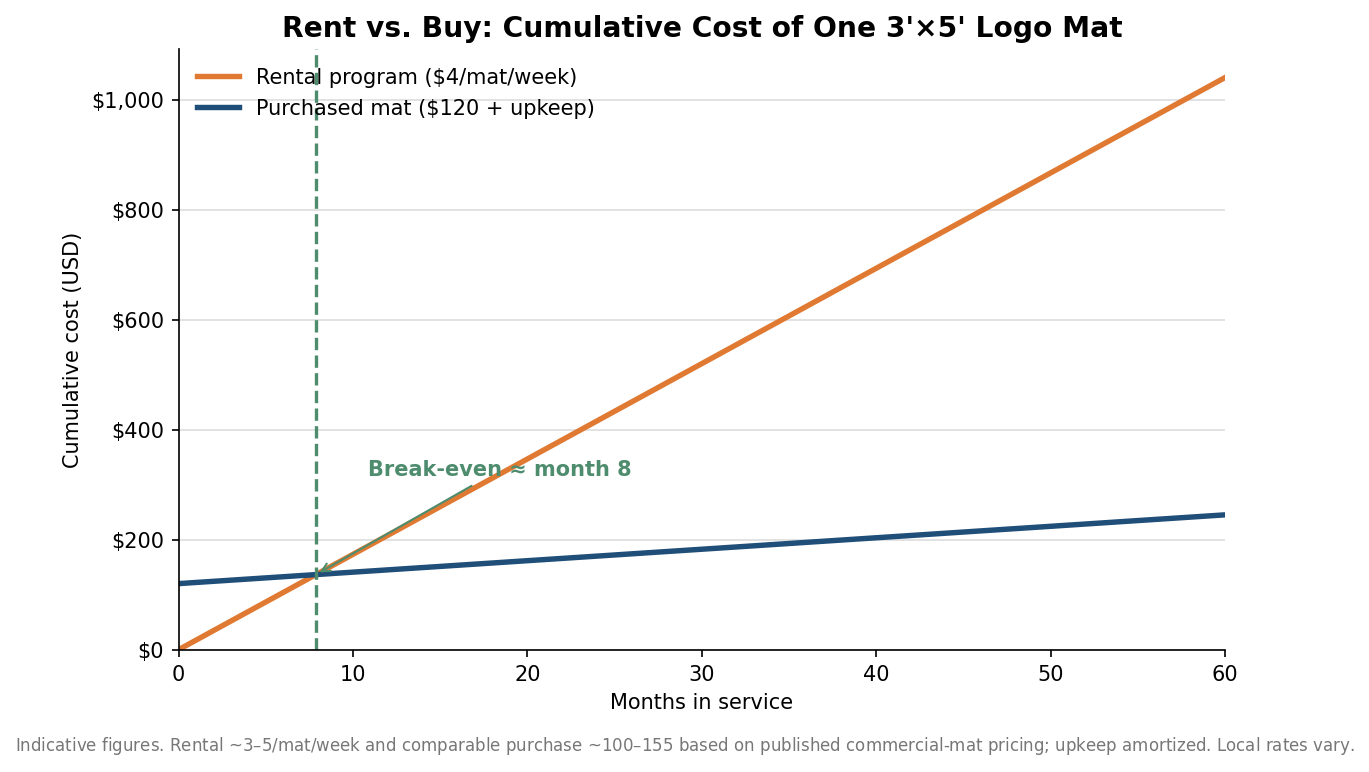
    Line chart comparing cumulative five-year cost of renting a 3x5 logo mat versus buying one, with break-even near month 8
    Rental cost climbs every week; a purchased mat pays for itself within the first year.

    For a typical 3-by-5 mat, the purchase pays for itself in roughly seven to eight months. After that point every week of rental is money you would not have spent if you owned the mat outright. Over five years the gap is not marginal: a rented mat can cost somewhere between $780 and $1,300, while the owned equivalent runs a bit over $200 once upkeep is included. Multiply across a fleet and the difference funds a lot of other things.

    Owning means you handle replacement and cleaning

    The honest counterweight to the cost argument is that a mat does not last forever, and a purchased mat is one you eventually replace on your own dime. How long it lasts depends almost entirely on how much grit walks across it. A low-traffic boutique entrance may get five to seven years out of a quality mat; a busy retail or lobby entrance moving hundreds of people a day will wear one down in two to three years; a transit hub or big-box door seeing well over a thousand daily visits can flatten the pile in a year or two.
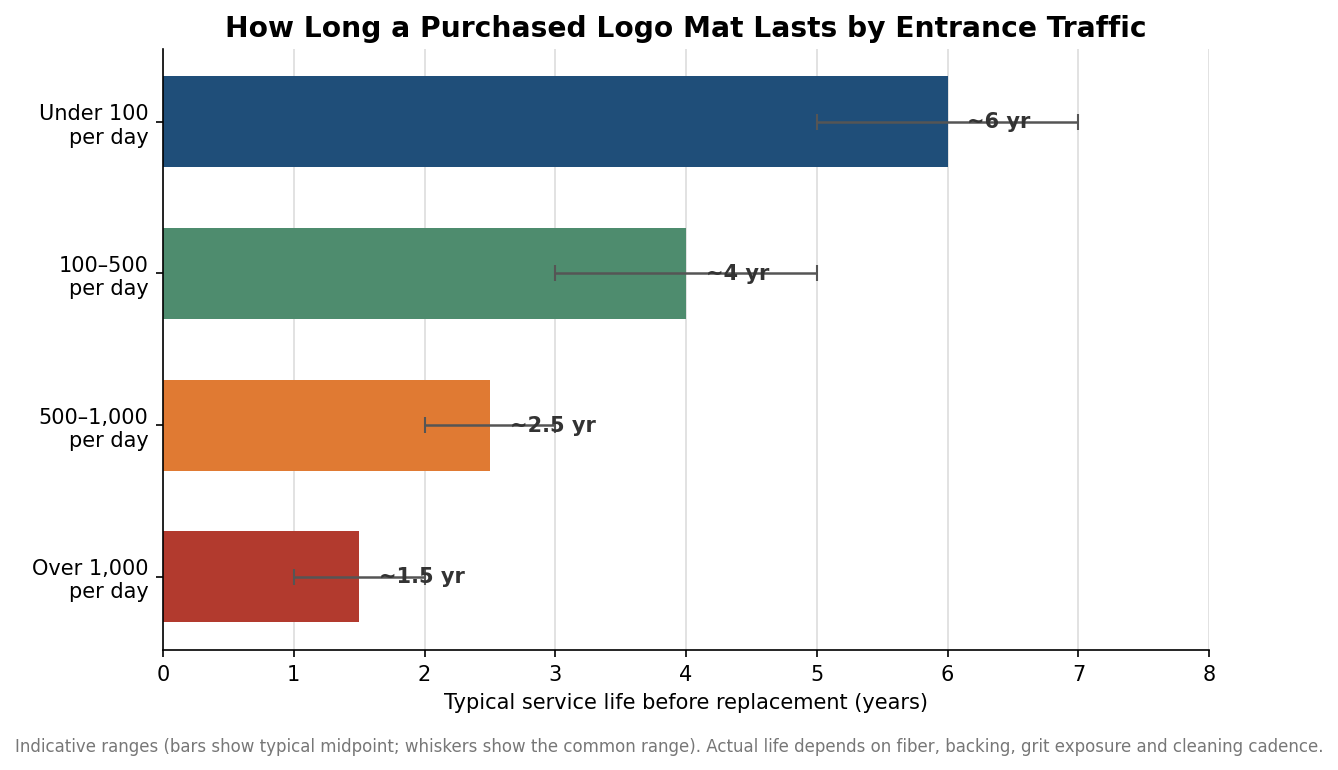
    Horizontal bar chart of how many years a purchased logo mat lasts by daily entrance foot traffic
    Higher foot traffic shortens mat life, but replacement cycles still cost less than continuous rental.

    These ranges are indicative rather than exact, and the biggest lever you control is cleaning. A mat that is vacuumed daily and extracted a couple of times a year holds its appearance and traps water far longer than one that is left to cake with grit, which grinds the fibers from below like sandpaper. Even at the heavy-traffic end, buying and replacing a mat every two years still comes in well under the cost of renting the same mat continuously.

    When renting still makes sense

    Rental is not a trap; it is a service, and some operations genuinely value the service more than the savings. If you have no in-house cleaning capacity, if your facility is subject to strict grease or contaminant handling where laundered mats are documented and controlled, or if you want a predictable operating expense with zero capital outlay and zero disposal responsibility, a rental program buys you exactly that. The swap-and-forget model also spares you from storing spares and managing replacements.

    What the numbers argue against is renting by default. If your entrances are ordinary, your cleaning crew already runs a vacuum every night, and you simply want a branded mat that greets customers and keeps the floor dry, buying is almost always the cheaper path once you get past the first year. The smart move for many buyers is a hybrid: own the mats at your standard, predictable entrances and reserve rental for the few high-contaminant or specialty spots where the laundering service earns its keep. Work out your own numbers with your real mat count and local rates before you sign anything that renews on its own.
  • The Compliance Checklist for Commercial Floor Mats: Fire, Slip, and ADA

    The Compliance Checklist for Commercial Floor Mats: Fire, Slip, and ADA

    A custom logo mat at a commercial entrance is easy to think of as branding, but the moment it is installed in a building open to the public it becomes a regulated floor surface. Three separate families of rules apply to it: flammability, slip resistance, and accessibility. A mat can be beautifully printed and still fail an inspection, void a lease clause, or create a liability if it ignores any of them. Here is what each standard actually requires and what to ask a supplier to prove.

    Flammability: what a fire rating on a mat really means

    Two different tests govern how a floor covering behaves in a fire, and they answer different questions. The first is the methenamine pill test, defined by ASTM D2859 and mandated federally under 16 CFR Part 1630 for carpets and rugs sold in the United States. A lit pill is placed at the center of a sample inside a steel frame with an eight-inch hole, and the material passes if the char does not spread to within one inch, 25 millimeters, of the edge of that hole. A production lot passes when seven of eight specimens meet that limit. This is a baseline ignition test that essentially all compliant carpet has to clear, so it is a floor, not a selling point.

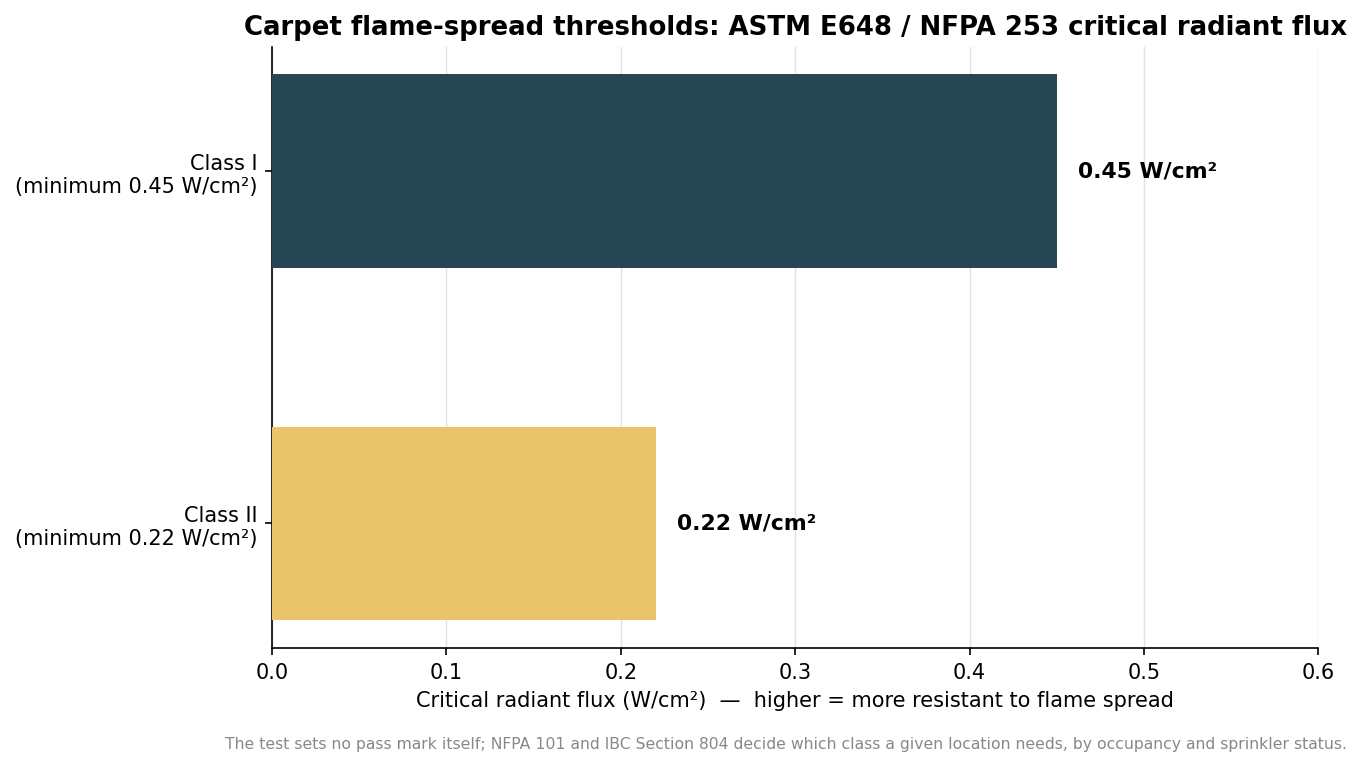
    The second test is the one that matters for commercial specification: critical radiant flux, measured by ASTM E648, which is technically identical to NFPA 253. It reports how much radiant heat energy a floor covering can withstand before flame stops spreading, in watts per square centimeter, and a higher number means the material resists flame spread better. Class I requires a critical radiant flux of at least 0.45 W/cm², while Class II covers the 0.22 to 0.44 W/cm² range. The chart below shows those thresholds.

    Horizontal bar chart of ASTM E648 critical radiant flux thresholds: Class I minimum 0.45 and Class II minimum 0.22 watts per square centimeter
    Critical radiant flux thresholds; the code, not the test, decides which class a location requires.

    The important nuance is that the test itself sets no pass mark. The requirement to use Class I versus Class II comes from the building and life-safety codes, principally NFPA 101 and Section 804 of the International Building Code, and it depends on the occupancy type and whether the building is sprinklered. As a general rule, Class I, the more demanding tier, is what gets specified for exit corridors and egress paths in many occupancies, while Class II may be acceptable in other spaces. Because the exact rule is code- and occupancy-driven, the safe move is to ask which class your local code requires for the specific location and to confirm the mat is documented to that class.

    Slip resistance: the numbers worth asking for

    Slip resistance is where the marketing language is loosest, so it pays to insist on a measured value and the method behind it. The current hard-surface standard, ANSI A326.3, sets a wet dynamic coefficient of friction, or DCOF, of at least 0.42 for interior floors expected to be walked on while wet, with a higher 0.55 threshold for wet or outdoor conditions. Separately, the National Floor Safety Institute designates a surface as high-traction at a static coefficient of friction of 0.60 or above. Either figure is only meaningful alongside the test method and whether it was measured wet or dry.

    Two honest caveats belong in any slip conversation. There is no single universal coefficient that guarantees safety across every surface and contaminant, and OSHA does not actually mandate a specific coefficient of friction for walking surfaces, despite the widely repeated 0.5 figure. For an entrance mat specifically, slip resistance has two parts: the traction of the walking surface itself, and the grip of the backing that keeps the mat from sliding on the floor beneath it. A mat that skates across a tile lobby is a hazard no matter how grippy its face is, so ask about both.

    Accessibility: the ADA rules a mat can quietly break

    The most common way a mat runs afoul of the ADA is by being a trip hazard or an obstacle to a wheelchair. The 2010 ADA Standards set clear numbers. Carpet and mat pile height is capped at 1/2 inch, measured to the backing, cushion, or pad, under Section 302.2, and the carpet must be securely attached so it cannot shift or buckle, with exposed edges trimmed and fastened the entire length to stop curling. A loose, thick, curling mat violates the spirit and often the letter of that rule.

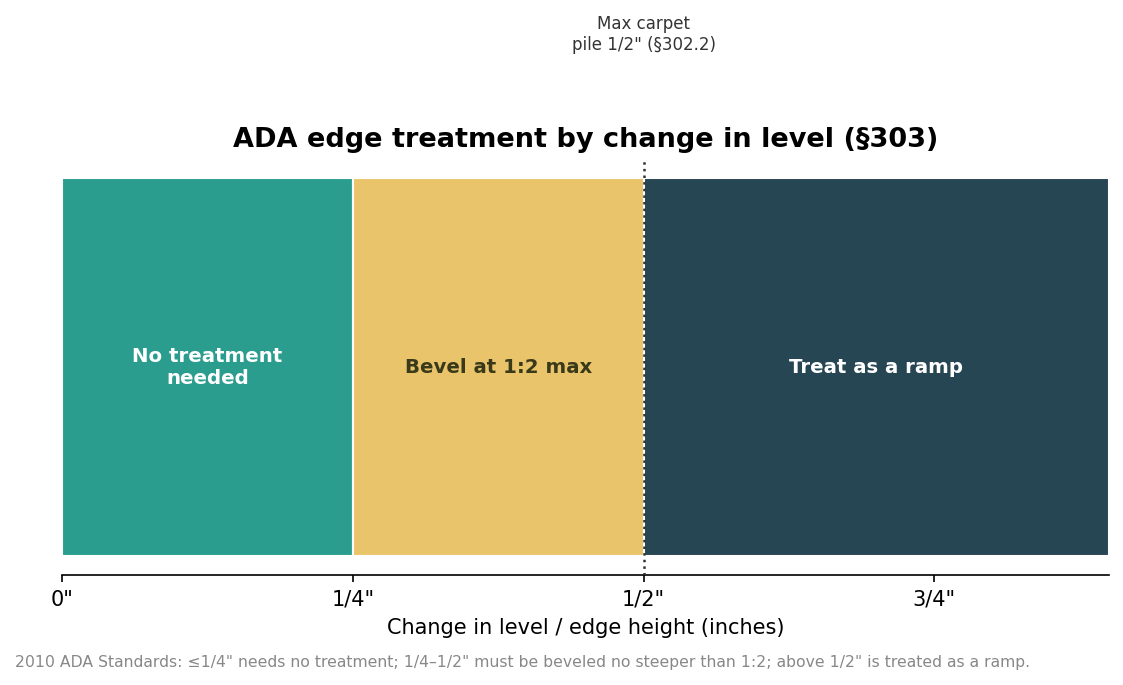
    Then there is the edge itself, treated as a change in level under Section 303. A vertical rise up to 1/4 inch needs no special treatment, a rise between 1/4 and 1/2 inch must be beveled at a slope no steeper than 1:2, and anything above 1/2 inch has to be handled as a ramp. The chart below maps those three zones. This is why low-profile mats with tapered, beveled borders exist: they keep the transition inside the range that needs no ramp while still stopping a wheel or a toe from catching.

    Stacked bar showing ADA change-in-level edge treatment zones: no treatment to 1/4 inch, bevel 1:2 from 1/4 to 1/2 inch, ramp above 1/2 inch
    ADA edge-treatment zones by height, with the 1/2-inch maximum carpet pile marked.

    How the pieces fit a real entrance

    Put together, the three standards point toward a fairly specific product for a public entrance. The mat should be thin enough that its edge stays within the 1/4-inch untreated range or is beveled at 1:2, its pile no more than 1/2 inch, its backing high-traction and heavy enough to stay put, and its fiber and construction documented to the critical radiant flux class your code requires for that location. None of these is exotic; entrance systems are built to hit all of them at once. The failure mode is buying on appearance and print quality alone and discovering the compliance gap after installation.

    What to request in writing

    Before a custom carpet or mat order is confirmed, ask the supplier to put five things on paper. Confirm the material passes the 16 CFR 1630 pill test, state the ASTM E648 critical radiant flux class and the actual W/cm² value, give a DCOF or slip-resistance figure with the test method and wet-or-dry condition, specify the finished pile height, and describe the edge construction and how the mat is secured. A supplier who can produce those numbers is selling a compliant floor surface; one who can only talk about colors and logos is selling a print, and the compliance gap becomes your problem at inspection time. The branding is the easy part, and it is worth making sure the surface underneath it meets the code it will live under.

  • How to Specify a Logo Mat: Fiber, Face Weight, Backing, and Print

    How to Specify a Logo Mat: Fiber, Face Weight, Backing, and Print

    A logo mat lives or dies on four line items, and none of them is the artwork. Two mats can carry the same printed logo and cost within a dollar of each other, yet one still looks sharp after a winter of salt and slush while the other has matted down, curled at the corners, and faded to a ghost. The difference is in the specification: the fiber on the surface, how much of it there is, what the mat is backed with, and how the print and edge are built. Here is how to read and write each of those four numbers so the mat you order survives the traffic you actually have.

    Start with the fiber, matched to the zone

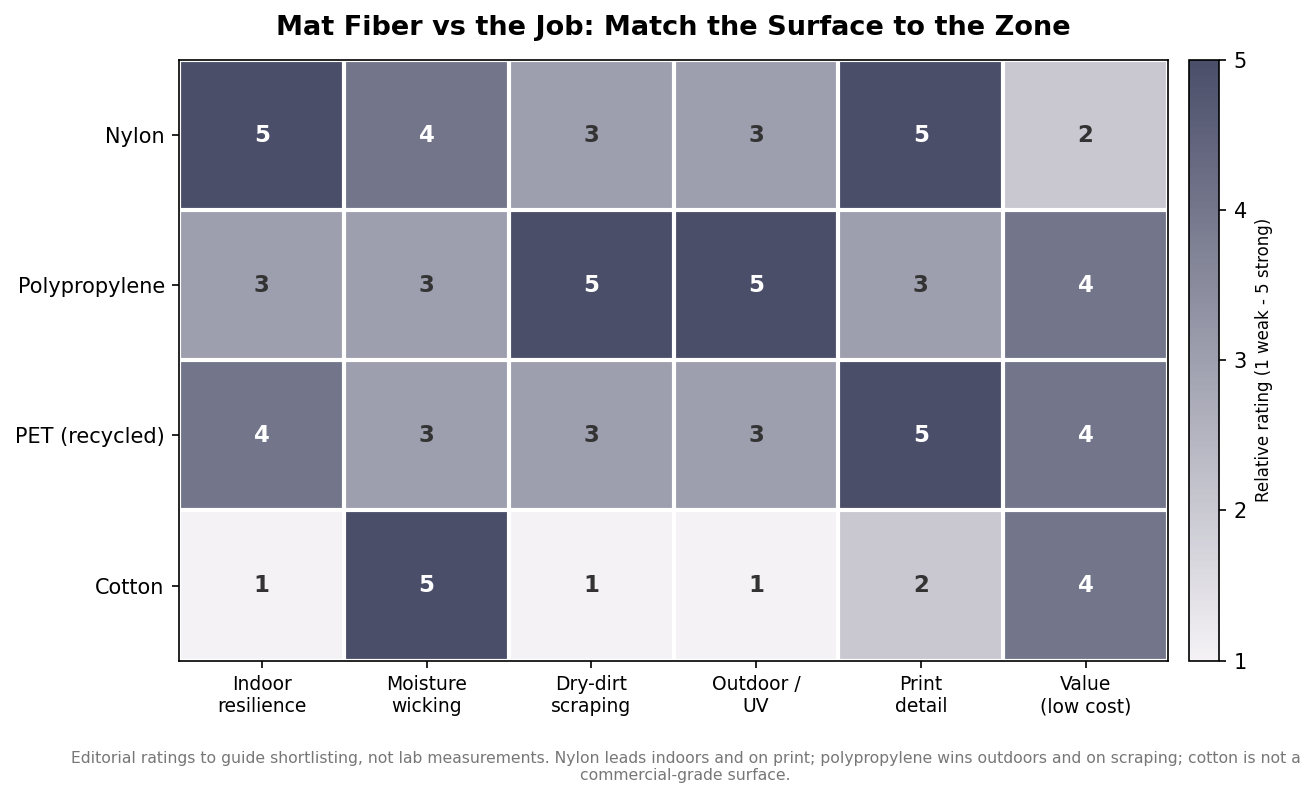
    The fiber is chosen by placement, not by preference. Nylon is the default surface for indoor, high-traffic logo mats: it holds color, resists crushing under constant footfall, and takes high-definition print, which is why it anchors most lobby and reception mats despite being the priciest fiber. Polypropylene, also called olefin, is the outdoor and scraper fiber, because it shrugs off moisture, UV, and chemicals and its coarse texture is genuinely good at scraping dry grit off shoes, though it crushes faster than nylon under heavy indoor use. PET, the recycled polyester spun from post-consumer plastic, has become a real option where sustainability matters, since it prints cleanly and holds up reasonably while carrying a recycled-content story. Cotton and similar absorbent fibers wick water well but flatten quickly and are not a commercial-grade surface, so keep them out of a specification for a public entrance.

    Heatmap rating mat fibers nylon, polypropylene, PET, and cotton across resilience, moisture, scraping, outdoor use, print detail, and cost
    Fiber choice follows the zone: nylon indoors, polypropylene outdoors, PET where recycled content counts.

    Face weight: how much yarn is actually there

    Face weight is the amount of surface yarn per square yard, quoted in ounces, and it is the single best proxy for how a mat will wear. Commercial-grade carpet mats generally run in the range of 28 to 42 ounces, and within that band heavier is better in two ways: more yarn gives the tufts room to render fine logo detail and gradients, and it gives the traffic more material to grind through before the pile thins and the design starts to look tired. A light face weight can look fine on day one and still be the reason a mat looks worn out a year early. When you are comparing quotes, ask for the face weight in ounces explicitly, because it is the number most likely to be quietly cut to hit a price, and it is invisible in a photo.

    The backing decides the lifespan

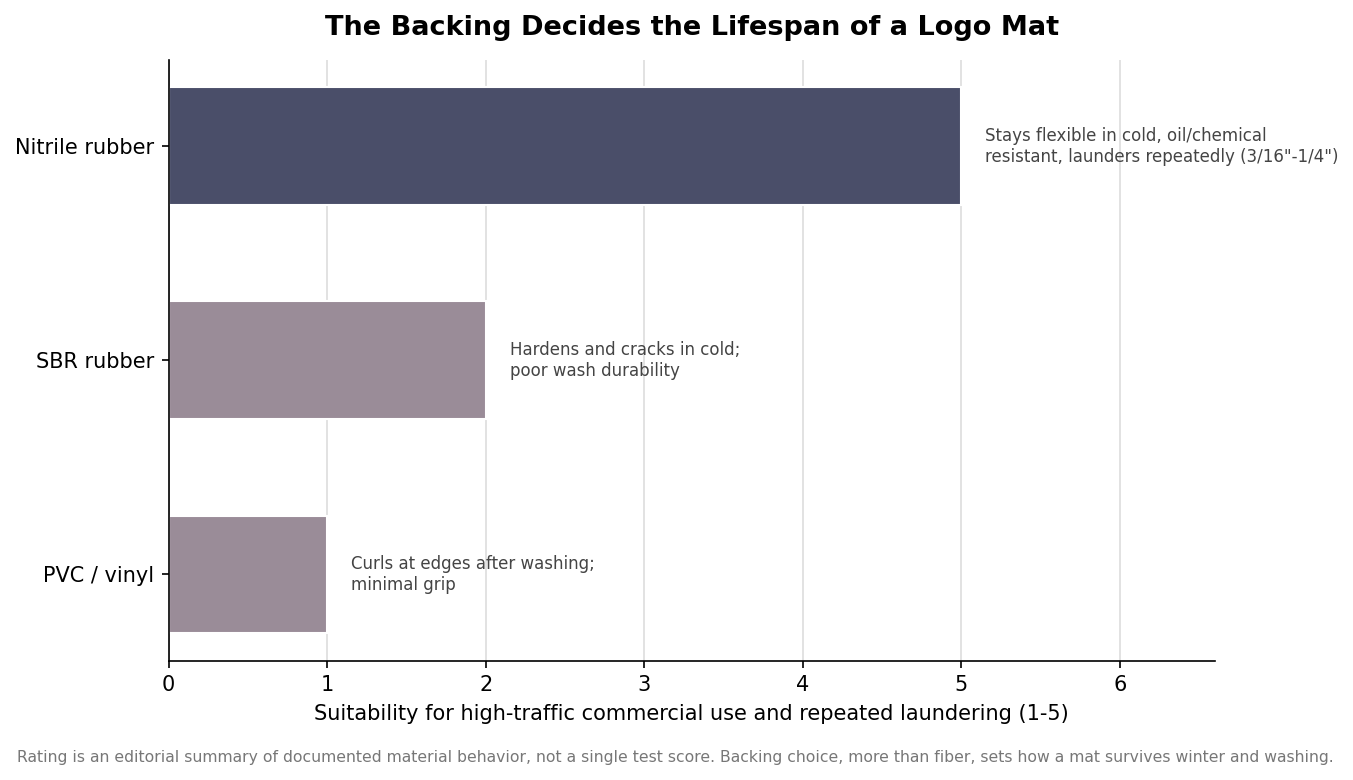
    If the fiber is what people see, the backing is what determines how long they see it, and it is where cheap mats give themselves away. Nitrile rubber is the commercial standard: it stays flexible in cold temperatures, resists oil and chemicals, grips the floor, and survives repeated commercial laundering, typically in a 3/16 to 1/4 inch thickness that also resists curling. SBR rubber is the budget substitute, and it hardens and cracks in the cold while holding up poorly to washing, which limits it to light-duty indoor spots. PVC or vinyl backing is cheaper still, offers minimal grip, and tends to curl at the edges after a few wash cycles, which is both a wear problem and a trip hazard, so it does not belong under real commercial traffic. Backing choice, even more than fiber, is what separates a mat that lasts from one that fails in a season.

    Horizontal bar chart rating nitrile, SBR, and PVC vinyl mat backings for high-traffic commercial use and repeated laundering
    Nitrile rubber backing outlasts SBR and vinyl in cold and through repeated washing.

    Print method and edge

    How the logo gets into the mat matters as much as how good it looks new. High-definition dye injection, in which computer-controlled jets drive color down into the fiber, gives photo-quality detail, gradients, and effectively unlimited color, and it is the right choice for a detailed indoor logo. For outdoor and scraper mats, inlay or tufted-in construction embeds the color into the mat structure so there is no printed ink layer to abrade away, trading some fine detail for color that does not wear off. The edge is the last detail and an easy one to overlook: a beveled rubber border eases the transition from floor to mat, which reduces the trip hazard at the perimeter and helps the mat sit flat for accessibility, while a simple serged edge is lighter and cheaper but offers less edge protection on a thick mat. It is also worth confirming whether the border color and the surrounding bleed are part of the printed area or a separate rubber frame, because that choice changes how much usable space your logo actually has.

    Putting the specification together

    Write the four numbers down before you request a quote. A complete logo-mat spec reads something like: solution-dyed nylon surface, 36-ounce face weight, 1/4-inch nitrile rubber backing, HD dye-injection print, beveled border, in the finished size you need. Match those choices to the placement, so an exterior scraper zone flips to polypropylene with an inlay print and an interior wiper zone stays on heavy nylon, and a sustainability-led lobby considers PET without dropping below commercial face weight or backing grade. The point of specifying all four is that it takes any single one of them off the table as a place for a supplier to silently economize.

    Get the fiber, the face weight in ounces, and the backing material in writing before you order, and if the placement sees weather or heavy traffic, ask for a sample to flex in the cold and check the edge. A mat that is underspecified does not fail loudly; it just quietly wears out ahead of schedule and takes your logo down with it.

  • Custom Logo Mats: Sizing and Speccing a Three-Zone Entrance System

    Custom Logo Mats: Sizing and Speccing a Three-Zone Entrance System

    Most people shop for a custom logo mat by picturing a single rectangle at the front door. The facilities that actually keep their floors clean think in zones instead. A well-designed entrance is a staged system that scrapes, then wipes, then finishes, and getting the lengths and materials right at each stage matters far more than the logo printed on top. Here is how to size and specify a custom entrance mat system so it does its real job and still looks sharp.

    The three-zone system, and why 15 feet is the number that matters

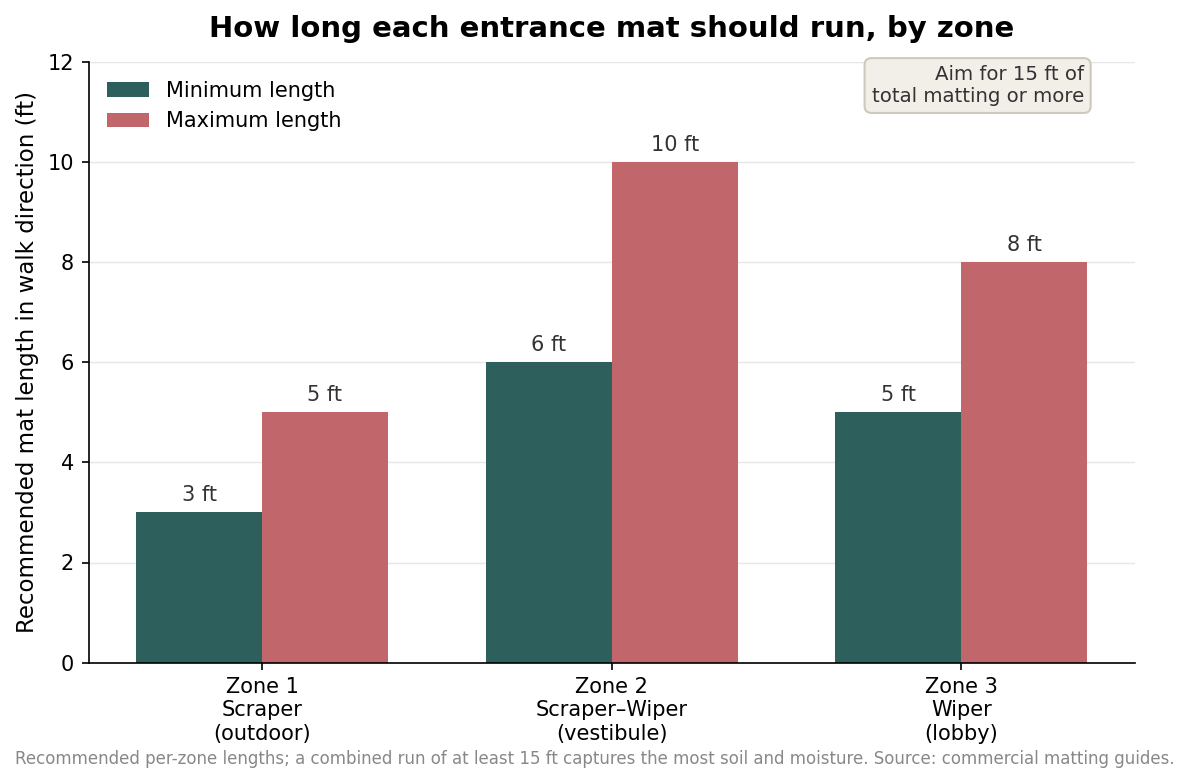
    Commercial matting guidance is built around three zones working in sequence. The first is an outdoor or entry scraper that knocks heavy soil, grit, and mud off the sole. The second is a vestibule scraper-wiper that removes what is left and starts absorbing moisture. The third is an interior wiper that captures fine dust and dries the shoe before it reaches your finished floor. Run together, a properly sized system is credited with stopping up to 85% of the soil and moisture that would otherwise be tracked inside. The single most useful rule of thumb is total length: aim for at least 15 feet of matting in the walking direction across the three zones, because a person needs roughly that many footfalls to leave most of the dirt behind on the mat rather than on your floor.

    Grouped bar chart of recommended entrance mat length by zone: scraper 3-5 ft, scraper-wiper 6-10 ft, wiper 5-8 ft
    Recommended run length for each entrance zone; combine to at least 15 feet total.

    Zone by zone: what each mat is actually doing

    Zone one, the scraper, runs about 3 to 5 feet and lives outside or in the doorway. It wants an aggressive surface — molded rubber cleats or a coarse scraping face — that can shed gravel and stand up to weather and UV, which is why outdoor mats lean on polypropylene faces and rubber construction rather than soft carpet. Zone two, the scraper-wiper, is the workhorse at roughly 6 to 10 feet, usually just inside the door in the vestibule. A bi-level or waffle surface traps debris below foot level while an absorbent face pulls in water; some designs hold well over a gallon of water per square yard behind a dam border. If a building only has room for one serious mat, this is the zone to prioritize. Zone three, the wiper, runs about 5 to 8 feet into the lobby, uses a dense carpet fiber, and exists to dry the shoe and grab the fine dust the first two zones missed. It is also where a printed logo reads best, because foot traffic has slowed and the surface is a smooth carpet face.

    Face fiber and backing: matching the build to the door

    Two construction choices decide how long a mat lasts and how well it holds a logo. The face fiber is usually nylon or polypropylene. Nylon is the standard for indoor logo mats because it retains color, resists crushing under heavy traffic, and prints with the most vivid detail; polypropylene is the outdoor and scraper choice because it shrugs off moisture, sunlight, and chemicals. Commercial-grade mats typically run a face weight of 28 to 42 ounces per square yard, and heavier tufting genuinely does buy sharper logo definition and a longer service life. The backing is the other half of the decision. Nitrile rubber, generally 3/16 to 1/4 inch thick, is the premium commercial standard because it stays flexible in the cold and resists oil and cleaning chemicals. Cheaper SBR rubber works for light indoor duty but stiffens in winter, and thin PVC or vinyl backing belongs only on lightweight promotional mats, where it tends to curl at the corners after washing. Whatever the build, keep the profile low and the edges beveled so the mat lies flat and does not become a trip hazard at the threshold.

    What dirt costs when the mats are too short

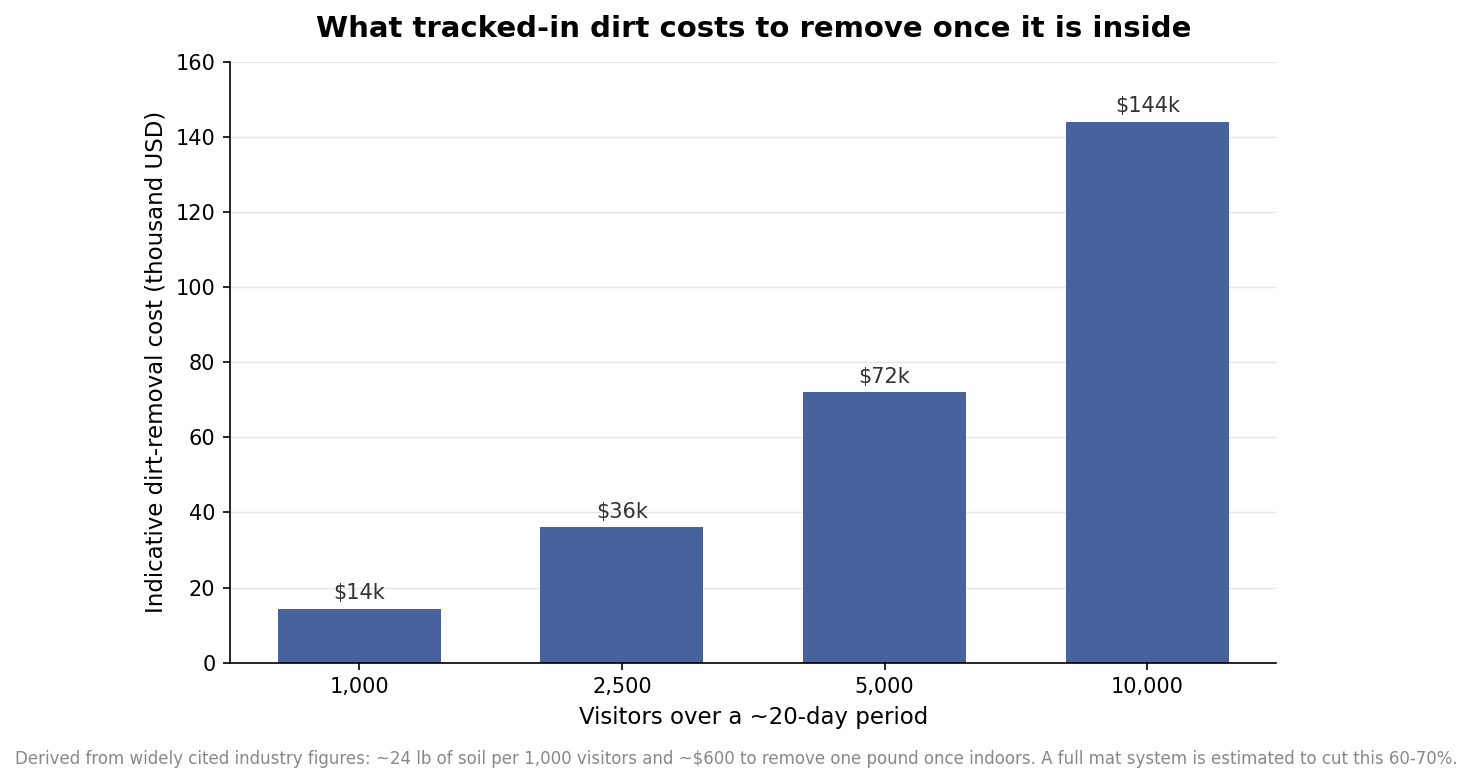
    The reason all of this pays for itself is that dirt gets dramatically more expensive the moment it crosses the threshold. A commonly cited industry figure puts tracked-in soil at around 24 pounds per 1,000 visitors over a roughly three-week span, and removing a single pound of dirt once it is inside a building is estimated to cost about $600 by the time you account for labor, equipment, and replaced flooring. Multiply that across real foot traffic and the numbers climb fast, as the chart below shows. A complete mat system is estimated to cut those interior cleaning costs by 60 to 70%, which is why the payback on a properly sized run is usually measured in months rather than years. Treat the exact dollars as indicative rather than a quote, but the direction is not in doubt: undersizing the matting to save a few feet is almost always a false economy.

    Bar chart of indicative dirt-removal cost rising with foot traffic, from 14k at 1000 visitors to 144k at 10000
    The cost of removing tracked-in dirt climbs quickly with foot traffic (indicative industry figures).

    Printing your logo so it survives the traffic

    Once the build is right, the decoration method determines how the logo ages. High-definition dye sublimation, in which computer-controlled jets drive color down into the fiber rather than sitting on top of it, is the method to ask for when you want photographic detail and color that will not wear off, because the dye becomes part of the yarn. Inlaid or precision-cut logos, where shapes are physically built into the mat, are the most permanent option for bold single-color marks and heavy outdoor use. Lower-cost surface prints and flocking exist, but they abrade with traffic and fade in sunlight, so they suit short-term promotional mats rather than a permanent entrance. When you request a quote, specify the zone and location, the finished size, the face fiber and backing you want, and supply vector artwork with your exact brand colors so the print shop can match them into the dye rather than approximating. Common stock footprints such as 3 by 5, 3 by 10, 4 by 6, and 4 by 8 feet cover most doorways, but a custom size cut to your actual opening is what lets the three-zone system work as designed.

  • Dyed or Printed: Why Entrance Carpets Fail

    Call or Text us: (929) 605-4397
    Specs

    Dyed or Printed: Why Entrance Carpets Fail

    One question decides it

    The most common complaint about a branded entrance carpet is that the logo looked worn out within a year. It is almost always the same specification error.

    Where the colour sits

    In a dyed carpet the pigment is inside the fibre, so a cross-section of a single strand is coloured all the way through. In a printed carpet the pigment sits on the tips. Walking on it abrades those tips, and the colour goes with them.

    Why a doorway is the worst case

    An entrance concentrates every visitor onto a few square metres, and they arrive with grit on their shoes. That is an abrasive under pressure, repeatedly, in exactly one spot. No surface print survives it for long.

    When printing is the right answer

    Events. A printed runner gives you unlimited colour, photographic artwork and any length you want, at a fraction of the cost of dyeing — and it only has to survive one evening. Using dyed carpet for a single premiere would be a waste.

    The rule

    Permanent and walked on: dyed. Temporary or photographic: printed. Minimum order is 12 carpets, production runs 2 weeks, and the mockup is free within 24 hours.

    Create your custom carpets now.

    Send your logo, quantity and date — you’ll get a free mockup and quote within one business day.

    Get a Quote
    GET A QUOTE
  • The Branding Surface Every Venue Already Owns

    Call or Text us: (929) 605-4397
    Business

    The Branding Surface Every Venue Already Owns

    People look down

    Venues spend heavily on signage competing for attention at eye level, then leave the one surface everybody is guaranteed to look at completely blank.

    The floor has no competition

    At eye level your sign is fighting every other sign, screen and display in the room. The floor has none of that. A branded entrance carpet is seen by everyone who enters, without competing against anything.

    You are buying the carpet anyway

    This is the argument that closes it. The floor covering is already in the budget. Choosing a dyed logo carpet over a plain one is a small increment on a cost you had already committed to, not a new line item.

    It works hardest in photographs

    At events the floor is in every arrival shot. In hotels it is in every lobby photograph a guest posts. That is coverage you do not have to ask anyone for, generated by a surface that was going down regardless.

    Specify it to last

    Dyed fibre for anything permanent, spares from the same batch, and colours matched to your brand references on the mockup. Send your artwork and dimensions and we will quote exactly. Minimum order is 12 carpets, production runs 2 weeks, and your free mockup arrives within 24 hours.

    Create your custom carpets now.

    Send your logo, quantity and date — you’ll get a free mockup and quote within one business day.

    Get a Quote
    GET A QUOTE
  • Custom Carpets: A Buyer’s Guide

    Call or Text us: (929) 605-4397
    Buyer’s guide

    Custom Carpets: A Buyer’s Guide

    The biggest surface you own

    Carpet is the largest branded surface in most buildings and the one specified with the least thought. The decisions that matter are made before anyone looks at a colour.

    Two questions settle most of it: how much traffic crosses this floor, and does the design need to survive years or one evening? Everything else follows from those answers.

    Dyed and printed are not the same product

    A dyed carpet has colour inside the fibre. A printed one has colour on top of it. At a doorway, footfall destroys a surface print within a season, which is why a printed entrance mat always looks tired and a dyed one does not. For events, printing is right — unlimited colour, short life, sensible cost.

    Tiles buy you maintenance, broadloom buys you continuity

    Broadloom runs the pattern unbroken across a whole room, which is what makes a floor look designed. Tiles break that continuity slightly but let you lift one damaged square instead of relaying the floor. In an office, that trade is usually worth making.

    Order spares from the same batch

    This is the cheapest insurance in flooring and it is constantly skipped. Dye lots vary. A replacement tile ordered two years later will not match precisely, so buy the spares with the original run and store them.

    What to expect when you order

    Send your artwork and your floor dimensions or stand plan. You will get a free mockup within 24 hours, unlimited free revisions, and you pay nothing until you approve it. Minimum order is 12 carpets and production runs 2 weeks, with faster turnaround available on express shipping.

    Create your custom carpets now.

    Send your logo, quantity and date — you’ll get a free mockup and quote within one business day.

    Get a Quote
    GET A QUOTE